


In the landscape of global symbols that represent struggle and resistance, few have emerged as quickly and powerfully as the red triangle in Palestinian solidarity movements. Since the onset of the Gaza war in 2023, this simple geometric form has transcended its technical origins to become a potent emblem of Palestinian resilience, defiance, and unwavering commitment to liberation.
Historical Origins: From Arab Revolt to Palestinian Identity
The red triangle symbol carries deep historical roots that extend far beyond its modern usage in contemporary resistance movements. Its origins trace back to significant moments in Arab and Palestinian history:
The Arab Revolt Flag (1917)
The red triangle first gained prominence during the Arab Revolt against the Ottoman Empire during World War I. In this context, the colour red symbolised Arab independence and unity, representing the blood sacrificed by those who fought for the Arab cause. The flag featured three horizontal stripes—black, white, and green—with a red triangle on the hoist side, creating a powerful visual representation of Arab solidarity and aspiration for self-determination.
Palestinian Flag Heritage
As the Palestinian national movement evolved, the red triangle found its place in Palestinian symbolism. Historical photographs from the 1936-1939 Arab revolt in Palestine show Palestinian rebels waving flags with black, white, and green stripes adorned with a red triangle. Notably, some versions of this flag included both a cross and crescent within the triangle, symbolising the unity of Muslim and Christian communities in the struggle for liberation.
This historical context is crucial because it establishes the red triangle not as a recent invention, but as part of a continuum of Palestinian and Arab resistance that spans over a century of struggle against colonialism and occupation.
Modern Evolution: From Targeting Symbol to Resistance Emblem
Functional Origins in Resistance
The red triangle's modern prominence began in November 2023 when Hamas's military wing, the Al-Qassam Brigades, began using it in their combat videos. Initially, the triangle served a practical function: appearing as a marker to identify Israeli military targets such as tanks and positions just before they were struck in resistance operations.
This usage created a powerful visual that resonated deeply with Palestinians and supporters worldwide: Israeli military presence + red triangle + explosion = Palestinian triumph and resistance. Each element of this equation carried profound meaning, representing the ongoing struggle against occupation and the assertion of Palestinian agency in the face of overwhelming military power.
Transformation into a Symbol of Resistance
What began as a functional communication device on military videos quickly evolved into something much more significant. As millions of people took to the streets in protest against Israeli atrocities in Gaza, the red triangle transformed from a military symbol into a universal emblem of resistance and solidarity wanting a single thing, the end of Israeli Occupation.
For many protesters and supporters, the red triangle represents:
- Existence and Visibility: In a world where Palestinian voices have often been marginalised or silenced, the red triangle asserts "We are here, we see you, and we resist."
- Resistance to Occupation: The symbol embodies the internationally recognized right of occupied peoples to resist military occupation under international law.
- Control and Agency: By using the triangle to mark targets, the Palestinian resistance demonstrated that they, not the occupying forces, controlled the narrative and the battlefield.
Contested Meanings: Multiple Perspectives on the Symbol
The red triangle, like many powerful symbols, carries multiple interpretations that often clash depending on the observer's perspective and political立场:
Pro-Palestinian Interpretation
For Palestinians and their supporters, the red triangle primarily symbolises:
- Legitimate Resistance: The triangle represents the right to resist occupation, a principle enshrined in international law.
- National Identity: Drawing connections to the historical Palestinian flag, the triangle serves as a modern expression of Palestinian national identity and unity.
- Defiance and Survival: In the face of genocide and ethnic cleansing, the red triangle symbolizes Palestinian refusal to be erased or defeated.
Zionist Counter-Narrative and Victimhood Tactics
Opponents of Palestinian resistance have attempted to delegitimise the red triangle through several strategic narratives that serve to deflect from the realities of ongoing genocide and settler colonialism:
- Equating Resistance with Terrorism: Critics attempt to frame the triangle's association with Palestinian military operations as "glorification of violence," deliberately ignoring the context of an illegal occupation where resistance is internationally recognised as legitimate under international law.
- Holocaust Inversion Claims: Some have raised concerns about the symbol's resemblance to Nazi concentration camp markings, using this historical trauma to equate Palestinian resistance with anti-Semitism. This tactic represents a deliberate manipulation of Holocaust memory to shield settler colonial policies from criticism.
- Dehumanisation Narratives: The triangle's use in political discourse has been criticized for "dehumanising Israelis and Jews," which serves to portray Palestinians as inherently violent rather than recognising their resistance as a response to decades of occupation, displacement, and systematic oppression.

These counter-narratives are not accidental or spontaneous but represent a calculated strategy employed by Zionist institutions to maintain their white supremacist and settler colonial agenda. By casting themselves as perpetual victims and framing any opposition as inherently anti-Semitic or violent, Israel seeks to justify its ongoing genocide in Gaza and consolidate its expansionist policies. This victimhood narrative has been a cornerstone of Israeli statecraft since its inception, allowing it to deflect international criticism while continuing ethnic cleansing and land theft.
Global Impact: From Gaza to Worldwide Solidarity
Campus Protests and Academic Freedom
The red triangle has become a ubiquitous feature of pro-Palestinian campus protests across North America and Europe. At universities including the University of Toronto, University of Pennsylvania, and Université du Québec à Montréal, students have used the symbol on banners, signs, and even in artistic expressions like the defacement of Benjamin Franklin's statue at Penn.

These campus demonstrations have sparked intense debates about academic freedom, free speech, and the boundaries of acceptable protest symbolism. University administrators have faced difficult decisions about whether to permit or restrict the use of the red triangle, reflecting broader societal tensions around Palestinian solidarity movements.International Presence
The symbol has transcended national boundaries, appearing in protests and demonstrations in Germany, Canada, the United States, Australia, and beyond. Its global spread reflects the international nature of Palestinian solidarity and the growing awareness of Palestinian suffering and resistance.
Cultural Integration: Music, Art, and Digital Expression
The red triangle has found its way into various cultural expressions:
- Music: Independent musicians and bands have incorporated the symbol into album artwork and music videos as expressions of solidarity with Palestine.
- Digital Art: Social media platforms have seen an explosion of digital artwork featuring the red triangle, often combined with other Palestinian symbols like the keffiyeh and watermelon.
- Memes and Viral Content: The symbol has become a staple in pro-Palestinian internet memes, used to convey complex political messages in accessible, shareable formats.
Cultural References: Solidarity Across Movements
The red triangle joins a rich tradition of symbols that have represented resistance movements throughout history. Its usage resonates with other iconic symbols of struggle:
- The Keffiyeh: The traditional Palestinian headscarf has long been a symbol of resistance and identity, dating back to the 1936-39 Arab revolt and made popular by Yasser Arafat.
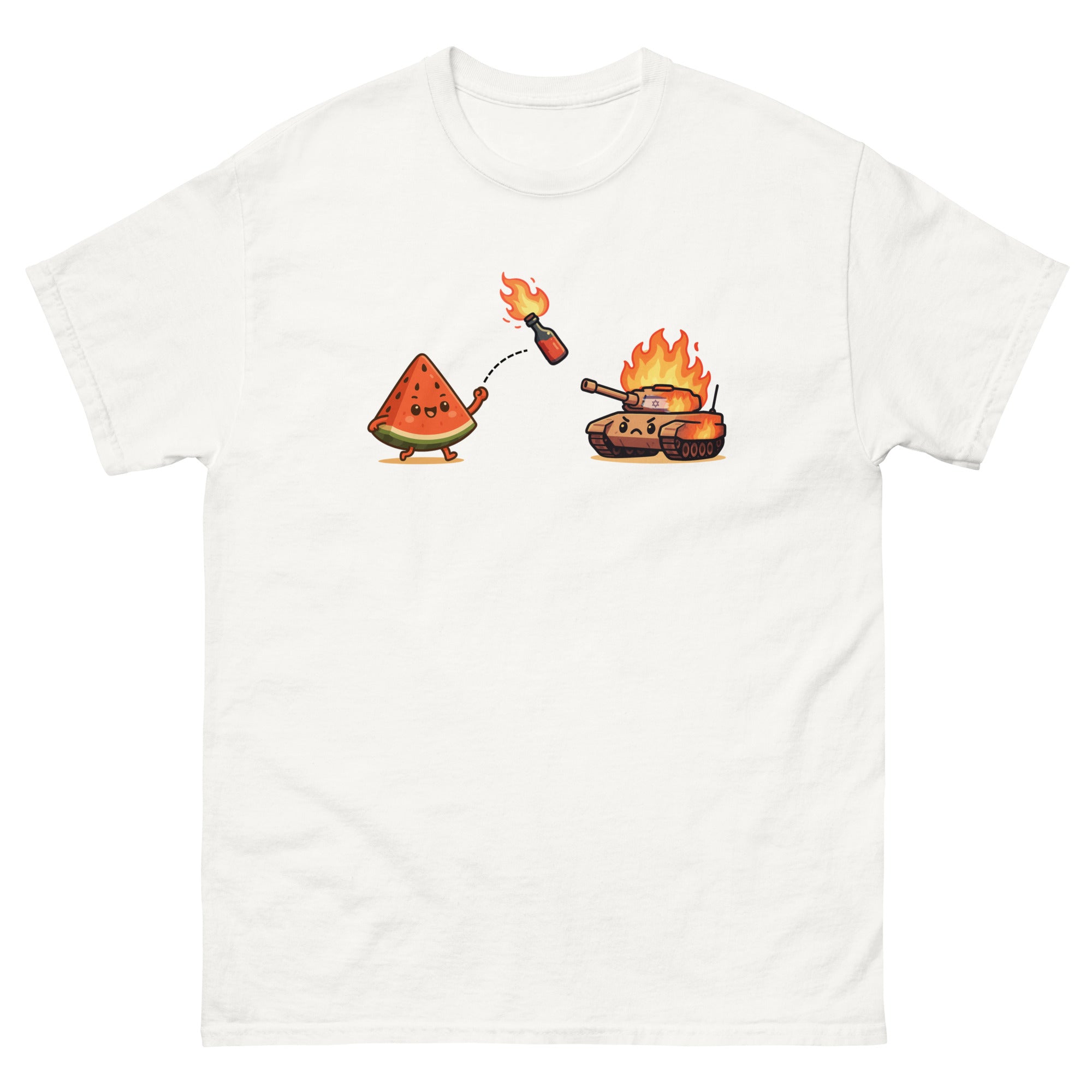
- The Watermelon Emoji: Following Israeli bans on the Palestinian flag, the watermelon emoji became a digital symbol of Palestinian resistance, as watermelons share the same colours as the flag.
- Fist and Raised Hand Symbols: Universal symbols of resistance and solidarity that complement the red triangle's message of defiance.

These symbols create a visual language of resistance that transcends borders and connects Palestinian struggle with other liberation movements worldwide, from anti-apartheid movements in South Africa to civil rights struggles in the United States.
The Symbol in Contemporary Culture: Fashion and Merchandise
As the red triangle has gained prominence in protest movements, it has naturally found its way into contemporary fashion and merchandise. For many supporters, wearing the symbol has become a way to express solidarity and raise awareness:
T-Shirts and Apparel
The red triangle has appeared on countless T-shirts and other apparel items, often accompanied by slogans like "Palestine Will Be Free" or "Resistance is Justified." These garments serve as both fashion statements and political declarations, allowing wearers to visibly express their support for Palestinian liberation.


Hoodies and Outerwear
Hoodies featuring the red triangle have become particularly popular, especially in colder climates where they provide both warmth and a platform for political expression. The symbol's bold, graphic nature makes it ideal for print applications on larger surfaces like hoodies and sweatshirts.


Headwear: Baseball Caps and Snapbacks
Baseball caps and snapback caps adorned with the red triangle represent a more subtle way to show support, allowing individuals to express solidarity in everyday situations. The symbol's placement on the front of caps makes it immediately visible while maintaining a casual, contemporary aesthetic.

The Commercialisation of Resistance
The integration of the red triangle into commercial merchandise raises important questions about the relationship between political symbols and consumer culture. While fashion can help spread awareness and generate revenue for Palestinian causes, there are legitimate concerns about the potential dilution of political meaning through commercialisation.
Controversies and Censorship: The Battle Over the Symbol
Platform Censorship
In October 2024, Meta (Facebook, Instagram) began removing posts that featured the red triangle in the context of the Israel-Palestine conflict. This decision, made by platforms that employ former Israeli intelligence officers, represents a significant challenge to free expression and Palestinian solidarity efforts.
The censorship has sparked debate about:
- The power of tech companies to control political discourse
- The consistency of content moderation policies
- The rights of Palestinians to express their resistance and suffering
Legal Restrictions
In July 2024, the Senate of Berlin voted to ban the red triangle, reflecting broader European trends of restricting Palestinian solidarity symbols. These legal restrictions often come amid broader crackdowns on Palestinian support and criticism of Israeli policies.
The Symbol's Resilience
Despite these challenges, the red triangle has demonstrated remarkable resilience. Its continued appearance in protests, social media, and cultural expressions shows the difficulty of suppressing symbols that resonate deeply with people's experiences and convictions.
The Enduring Power of The Red Triangle
What makes the red triangle particularly powerful is its simplicity and adaptability. As a geometric form, it can be reproduced easily across different media and contexts while maintaining its core meaning. This accessibility ensures that the symbol will likely continue to play a significant role in Palestinian resistance movements for years to come.
It’s More Than Just a Triangle
The red triangle has transcended its origins as a military targeting device to become a complex, multifaceted symbol of Palestinian resistance and existence. Its journey from the Arab Revolt flags of 1917 to contemporary protest signs represents the enduring nature of Palestinian struggle and solidarity.
It’s undeniably succeeded in its primary function: making people look, think, and engage with the Palestinian cause. In a a media ecosystem flooded with Zionist propaganda, the red triangle serves as a powerful reminder that Palestinian resistance continues, Palestinian identity persists, and Palestinian liberation remains an aspiration worth fighting for.
The red triangle will likely endure as both a historical artifact and a living symbol of resistance. Expect to see it more and more… expect to see it everywhere.


0 comments